Banff National Park: The Complete First-Timer's Guide
Banff is one of the most visited places in Canada, and once you arrive it’s obvious why: turquoise glacier-fed lakes, peaks rising above the treeline, wildlife alongside the road. Here’s everything you need before your first visit — when to go, how to get there, what to see, and how to make the most of every hour.
What is Banff National Park?
Canada’s oldest national park, established in 1885 and part of the Canadian Rocky Mountain Parks UNESCO World Heritage Site. It covers 6,641 km² of the Alberta Rockies, from the Trans-Canada north along the Icefields Parkway to the Jasper boundary. It’s anchored by the town of Banff — a full-service mountain town — with Canmore just outside the eastern gate. From Calgary it’s about 90 minutes west. A Parks Canada day pass is required: as of 2026, $11.25/adult (youth under 18 free) or $22.50 for a group vehicle pass (up to 7). The Discovery Pass ($83.50/adult) covers all Canadian national parks for 12 months.
| Banff at a glance | |
|---|---|
| Established | 1885 — Canada’s first national park |
| Size | 6,641 km² |
| Nearest city | Calgary — 128 km (~90 min) |
| Day pass (2026) | $11.25/adult · $22.50/vehicle (up to 7) |
| Best time to visit | June–September for lakes; late September for larches; winter for frozen falls |
| Getting around | Drive, Parks Canada shuttle, or guided tour |
| Must-see | Lake Louise · Moraine Lake · Johnston Canyon · Icefields Parkway |
When to go?
Every season delivers something different. June–July is peak: lakes at their most vivid, wildflowers, light past 10 PM — with crowds and lake parking restrictions as the trade-off. August runs similar, with frequent wildlife and a slight late-month easing. September–October are arguably best for experienced visitors — larch season peaks late September, crowds thin, temps stay comfortable for hiking. November–March is spectacular in its own right: snow-covered peaks, frozen lakes, ice skating on Lake Louise, cross-country skiing and winter wildlife tours; temps can hit −20°C, so layering isn’t optional. April–May is shoulder season — quieter, but some high roads stay closed into late May, and Moraine Lake access doesn’t open until June 1; late May can be a sweet spot.
Getting to Banff from Calgary
Banff is 128 km west on the Trans-Canada, roughly 90 minutes. Driving gives flexibility but comes with two real problems: Moraine Lake Road has been closed to private vehicles since 2023 (access via Parks Canada shuttle — book early — or a guided tour), and Lake Louise parking fills by 7 AM on summer weekends. A guided tour from Calgary solves both at once: central downtown pickup, driving handled, access secured, lakes on schedule — plus a local guide who explains what you’re seeing and spots wildlife you’d miss. Our Calgary pickup is the bus stop at 206-178 4 Ave SE (across from the Delta Hotel Downtown); we also pick up from Canmore (2801 Bow Valley Trl) and Banff (Caribou Lodge & Spa, 521 Banff Ave).
What to see
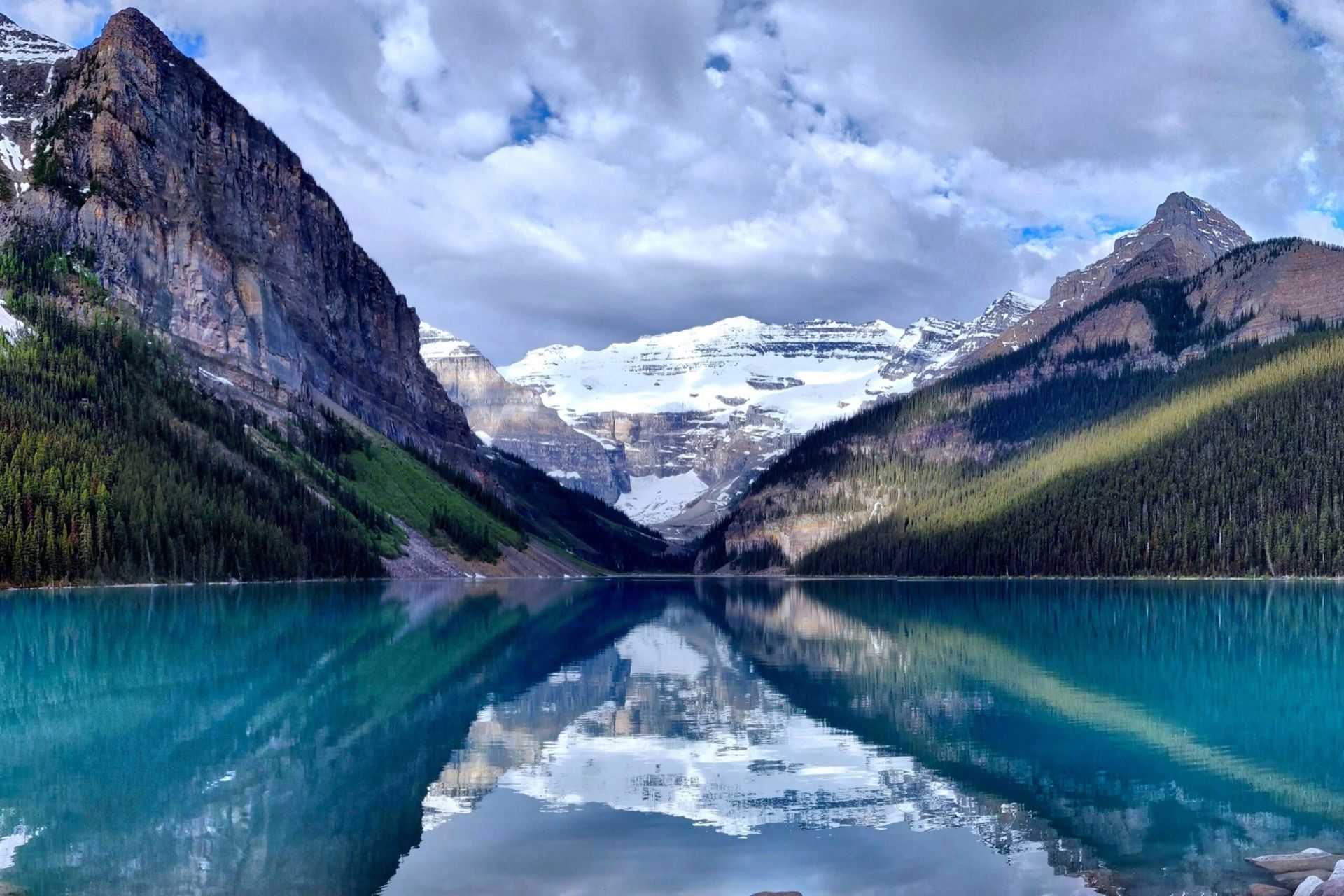
- Lake Louise — the image most people picture: blue-green water backed by Victoria Glacier. The colour comes from rock flour (fine glacial sediment) scattering light in the blue-green spectrum; brightest in summer and early fall. The lakeshore path is an easy 2 km with views from every angle; the Fairmont Chateau sits right at the water’s edge.
- Moraine Lake — many who’ve seen both say Moraine surpasses Lake Louise for visual impact. Ringed by the Valley of the Ten Peaks, it glows electric teal in June–July. The classic viewpoint is the Rockpile, a short scramble to one of the most photographed scenes in Canada. Private vehicle access is restricted — plan accordingly.
- Johnston Canyon — one of the most rewarding easy walks in the park, following a narrow canyon on catwalks bolted into the walls, past the Lower Falls (1.1 km) and Upper Falls (2.7 km). In winter it freezes into blues and greens; ice-walk tours run December–March.
- The Icefields Parkway — Highway 93 North runs 230 km from Lake Louise to Jasper, widely regarded as one of the world’s most scenic drives. Peyto Lake, Bow Lake, Crowfoot Glacier, Sunwapta and Athabasca Falls, and the Columbia Icefield near the midpoint. Our Icefields Parkway Full-Day Tour covers the key stops from Calgary.
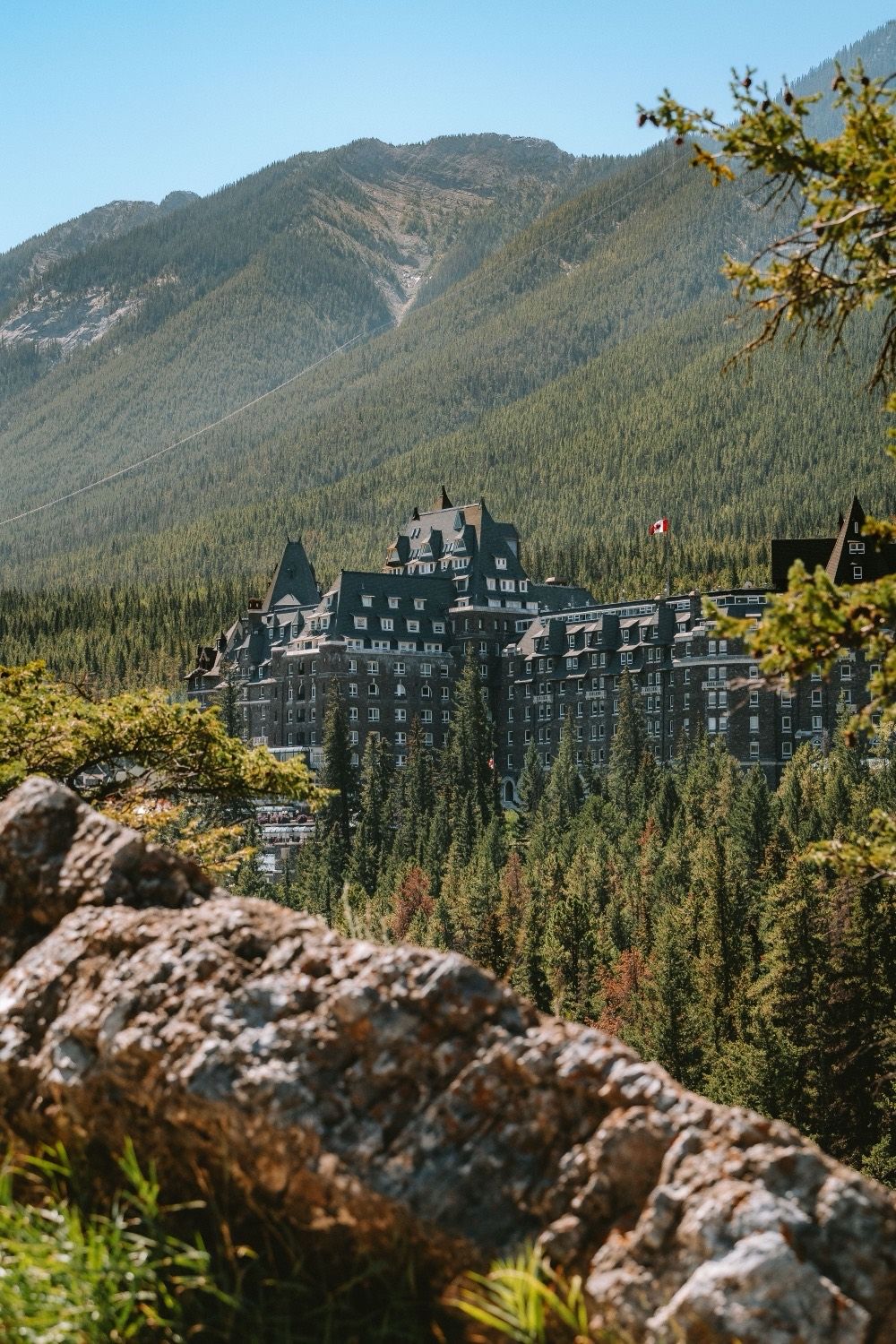
- Banff townsite — often underestimated. Banff Avenue has good restaurants, gear shops and galleries; Bow Falls is a five-minute walk from the town centre; Surprise Corner frames the classic Fairmont-and-river view.
Wildlife
A defining part of any Banff visit. Speed limits on park roads are strictly enforced and wildlife-corridor fencing guides animals across the Trans-Canada. Elk are the most commonly sighted large animal, often near the townsite morning and evening; during the fall rut (September–October) bulls bugle across the valley. Bighorn sheep are regularly seen on rocky slopes between Banff and Canmore. Black bears and grizzlies are present throughout, most often in spring (May–June) and fall near berry-rich areas — wildlife jams are regular on the Parkway. Keep your distance, stay near your vehicle, and never approach or feed wildlife. Deer, coyotes, wolves, lynx and wolverine also live here, though the last three are rarely seen. We run these roads year-round and know where wildlife is most frequently spotted by season.
How much time do you need?
- One day — you can hit the highlights well-planned; that’s exactly what our flagship Banff in a Day covers, with pickup and return from Calgary.
- Two to three days — add the Icefields Parkway, townsite time and shorter walks; three days opens up Emerald Lake in Yoho, Grassi Lakes and Grotto Canyon near Canmore, or an evening stargazing tour.
- Four days or more — Banff rewards slow exploration; the park shifts character dramatically from dawn to dusk.
What to pack
Conditions change quickly at elevation — even in summer the lakes run 5–10°C cooler than Calgary. Bring layers (a light down or fleece is useful even in July), a packable rain jacket, sturdy footwear (the Rockpile has loose rock; the Johnston Canyon catwalk gets slippery), water and snacks (food is limited away from town), and sunscreen and sunglasses (reflected light at altitude is intense). On our guided tours, snacks, water and park entry fees are included.
The honest answer on how to do Banff right
Go with a local guide. The park is large, vehicle-access logistics have gotten more complicated, and the difference between a guided and independent visit often comes down to whether you actually get into the places you came to see — Moraine Lake without the right access plan means a possibly sold-out shuttle; Lake Louise at 9 AM on a July Saturday means a full lot. A guided tour handles access, permits, timing and route, so the day is spent in the park rather than managing logistics. Our most popular first-timer option is Banff in a Day: Lakes & Johnston Canyon — an 11-hour tour covering Lake Louise, Moraine Lake, Johnston Canyon, the townsite, Bow Falls and Surprise Corner. For more ground, Banff & Beyond extends into Yoho; for something different, the Icefields Parkway Full-Day Tour trades lakes for raw glacier and mountain. Browse all tours and book at banffjourney.org/tours.
FAQ
Do I need a Parks Canada pass?
Yes, per person or per vehicle; included on any Banff Journey tour.
Is Banff worth visiting in winter?
Yes — frozen waterfalls, easier wildlife spotting, dramatically fewer crowds, plus ice walking and skating. We run tours year-round.
Can you see both Lake Louise and Moraine Lake in one day?
Yes — they’re ~14 km apart; our half-day tour covers both in 5 hours from Canmore or Banff.
What’s the difference between Banff and Jasper?
Both are Alberta Rockies parks; Banff is larger, more developed and closer to Calgary, Jasper wilder and quieter at the north end of the Parkway (~4 hours from Calgary). Our Icefields Parkway tour travels through both.
How far is Banff from Calgary?
128 km west on the Trans-Canada, about 90 minutes.
Our guides run these routes year-round. Book a guided day tour from Calgary, Canmore or Banff and let us handle the logistics. Browse All Tours