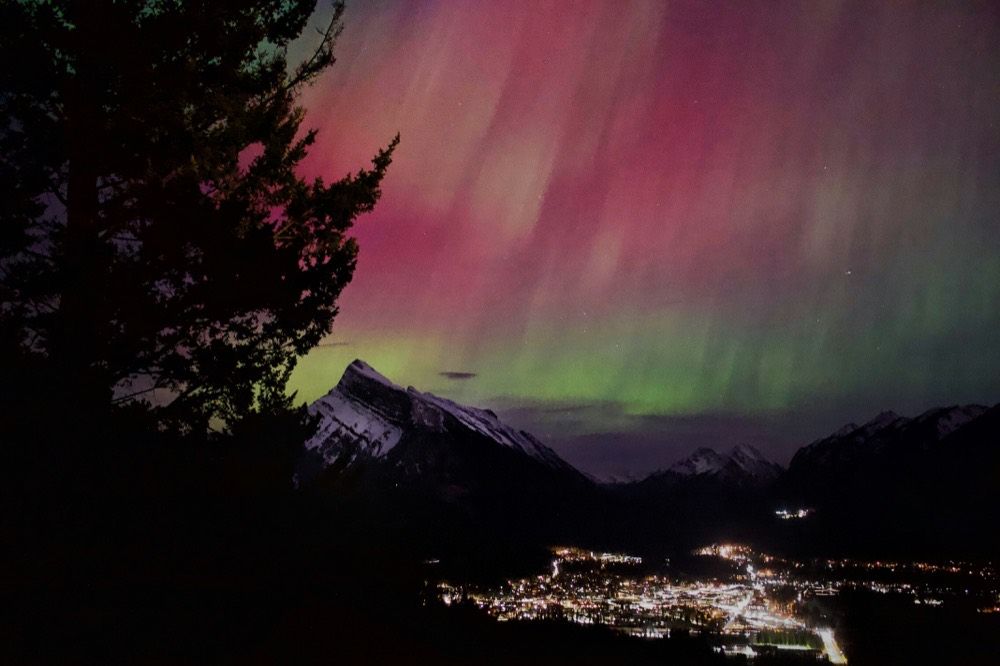
Northern Lights in Banff: When & Where to See the Aurora
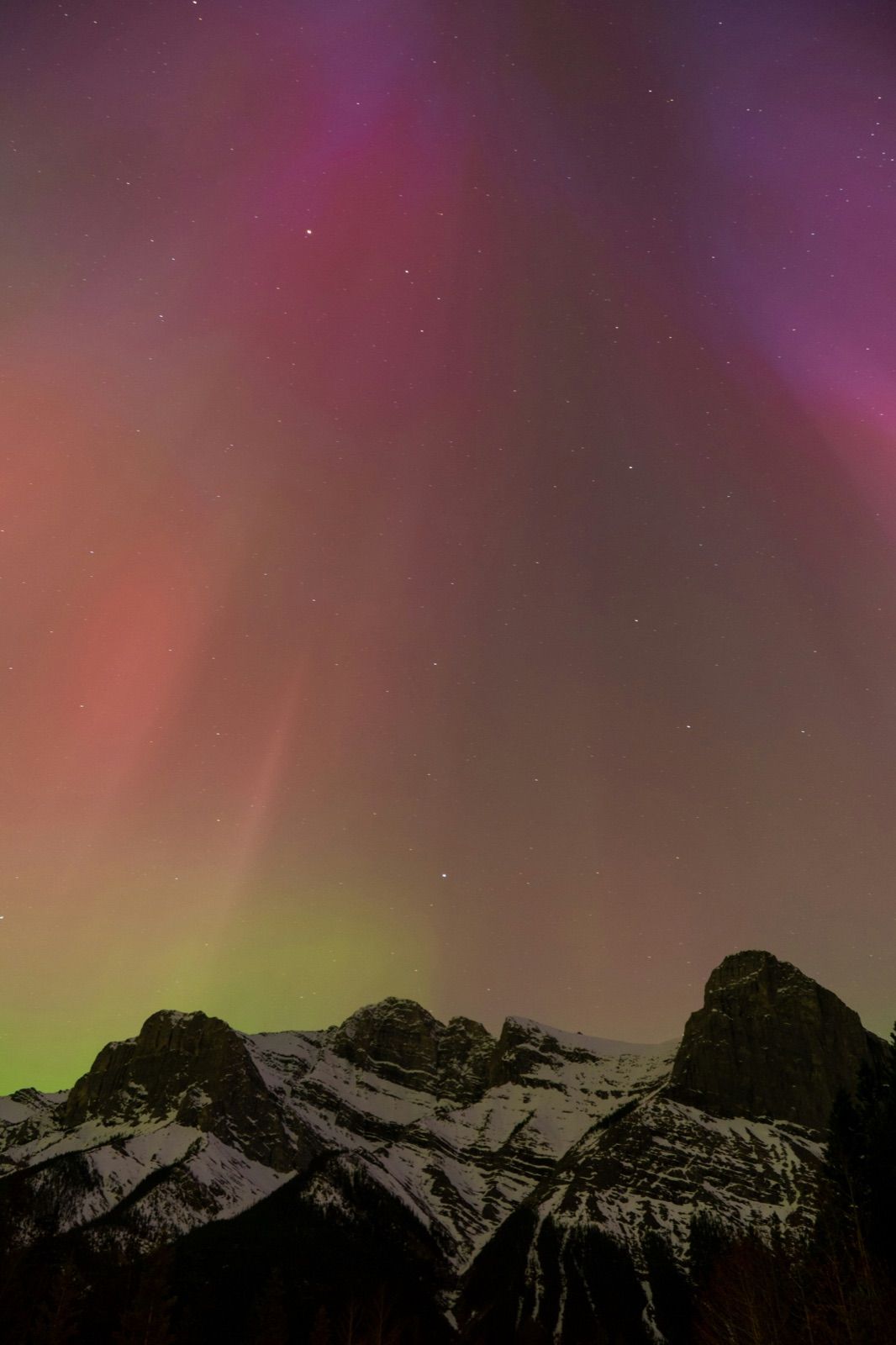
The northern lights over a wall of snow-capped peaks is one of the most spectacular things you can witness in the Canadian Rockies — and one of the least predictable. Banff does get the aurora, and in a good year the sky glows green and pink over the mountains. But it isn’t Yellowknife, and anyone promising a guaranteed show isn’t being straight with you. Here’s the honest guide: when to look, where to go, and how to give yourself the best possible odds.
Can you see the northern lights in Banff?
Yes — but with a realistic caveat. Banff sits at about 51° north, further south than the classic aurora-hunting destinations, so the lights here need stronger geomagnetic activity to appear than they do in the Yukon or Northwest Territories. When a solar storm is strong enough, the aurora pushes south and lights up the sky over the Rockies — and the recent run of powerful storms has produced some of the best displays Banff has seen in years. On an average night you won’t see it; on an active one, framed by mountains, it’s unforgettable.
Two pieces of good news for the next while: solar activity is near the peak of its 11-year cycle, which makes the coming couple of years some of the best in a decade for aurora this far south — and the Rockies offer genuinely dark skies once you’re away from town.
When is the best time to see the aurora in Banff?
Three things have to line up: darkness, clear skies, and solar activity.
- Season: roughly late August through mid-April. Summer nights this far north barely get fully dark, so the aurora season really begins as the nights lengthen in fall. The longest, darkest nights of November to February give you the most hours of true darkness to work with.
- Time of night: the hours around local midnight — call it 10 p.m. to 2 a.m. — are usually best.
- The moon: aim for nights near a new moon; a bright full moon washes out faint aurora.
- The sky: it has to be clear. A storming aurora behind clouds is a non-event, so watch the mountain weather.
Where to see the northern lights near Banff
The enemy is light — both town light and moonlight. You want a dark spot with an open view to the north:
- Lake Minnewanka and Two Jack Lake — dark, north-facing water just minutes from Banff town, and a classic aurora foreground.
- Vermilion Lakes — easy to reach, with the reflection of any display in the still water.
- The Bow Valley and up toward Bow Lake / Peyto Lake — deeper into the park, darker still, with big open horizons.
Wherever you go, give your eyes 20–30 minutes to adjust to the dark, and keep your phone screen off — the aurora often starts as a faint grey-green arc the eye can barely register before it strengthens.
How to check the aurora forecast
You can dramatically improve your odds by watching the forecast:
- AuroraWatch (University of Alberta) issues Alberta-specific alerts when geomagnetic activity is high enough to see the lights locally.
- NOAA’s Space Weather Prediction Center publishes the Kp index — a 0–9 scale of geomagnetic activity. For Banff’s latitude you generally want Kp 5 or higher to have a real chance.
Pair a high Kp forecast with a clear, moonless night, and that’s your window.
Tips for seeing (and photographing) the aurora
- Get away from light and look north. Even a short drive out of town makes a big difference.
- Be patient, and go late. The aurora ebbs and surges; a quiet sky at 10 p.m. can erupt at 1 a.m.
- Dress for deep cold. Prime aurora season is the dead of a Rockies winter, and you’ll be standing still in the dark for a long time.
- Bring a camera, not just your eyes. A long-exposure shot (a few seconds on a tripod) reveals colour and structure the naked eye can’t see — sometimes the camera catches a display you’d otherwise walk past.
See it on our Dark Sky Stargazing tour
Here’s where we can genuinely help. Our Banff Dark Sky Stargazing Experience — $250 is built around the darkest skies inside Banff National Park, at the time of night when the sky is at its best — which is exactly the recipe for catching the aurora when it’s active. We can’t promise the northern lights (no honest operator can), but we can promise the dark skies and the timing that give you the best shot — and on the many nights the aurora doesn’t perform, you still get the Milky Way, a telescope, and a guide who knows the winter sky.
For what else each month brings, see our best time to visit Banff guide, and for fitting a night under the stars into your trip, the Banff itinerary guide.
FAQ
Can you see the northern lights in Banff?
Yes, though not on demand. Banff is far enough south that the aurora needs a strong solar storm to appear, but when it does, the display over the mountains is spectacular — and solar activity is currently near its cyclical peak.
What’s the best time of year for northern lights in Banff?
Late August to mid-April, with the darkest, longest nights from November to February offering the most viewing hours. Summer nights are too short and bright.
What time of night is best for the aurora?
The hours around local midnight — roughly 10 p.m. to 2 a.m. — on a clear, moonless night.
Where’s the best place near Banff to see the aurora?
Dark, north-facing spots away from town: Lake Minnewanka, Two Jack Lake, Vermilion Lakes, and deeper into the Bow Valley toward Bow and Peyto Lakes.
Are the northern lights guaranteed on your tour?
No — no honest operator can guarantee the aurora. What we guarantee is the darkest skies inside the park at the right time of night, plus the Milky Way and a telescope on nights it doesn’t appear.
Do you need a special camera to photograph the aurora?
Any camera that allows a few-second exposure on a tripod will do — even many phones now have a night mode that captures the colour your eyes can’t quite see.
Come for the darkest skies in the Rockies — and the aurora when it shows. Year-round evening departures from Canmore and Banff. Browse All Tours